Blog · Christina Bachini
Are you really changing people or just managing behaviour?
Why does anyone come to a counsellor, a therapist or a coach? Rarely because they simply want someone to talk to. They come because something isn’t working. They’re stuck. They can’t solve it alone. Or they sense there’s more to who they could become.
The question for us, as practitioners, is how deep we are prepared to go with them.
I grew up with a father who was a psychoanalyst. His clients carried profound psychological wounds, and he often said his role was to keep people out of psychiatric hospitals. He was very successful at it. That shaped my understanding of human behaviour long before I entered the people development profession myself.
After my father died, my own life became chaotic, and personal development stopped being a luxury and became a necessity. It led me to train as a counsellor and psychotherapist, and later to specialise in team dynamics. For over 40 years I’ve worked with teams and with individuals, and one truth has remained constant:
People don’t stay stuck because they lack motivation. They stay stuck because something is hidden from their awareness.
When clients can’t think their way forward
That curiosity is what brought Lindsey and me together. Although we both trained as traditional coaches, we found ourselves asking the same question: what happens when clients can’t think their way forward?
Our answer was surprisingly simple. Instead of asking more questions about the goal or the problem, we invite clients out of their heads and into their bodies, through images, drawings, colours, maps or metaphors: whatever naturally represents the issue they’re wrestling with. Once they have their image, we use our 9 Core Questions to explore what lies beneath it.
Without fail, the conversation moves beyond conscious thinking. Hidden patterns emerge. And when what was unconscious becomes conscious, the real work begins.
Show me
A leader came to me carrying what felt like several lives colliding at once: the relentless pressure of work, a diary filled with travel, the responsibility of family life, and an almost constant sense that his purpose in life was to meet everyone else’s needs. Many practitioners will recognise him.
He didn’t need help analysing the situation. He could already explain, with impressive clarity, exactly why he was exhausted and close to burnout. So instead of asking him to tell me more, I asked him to show me, by drawing a map of what his experience felt like.
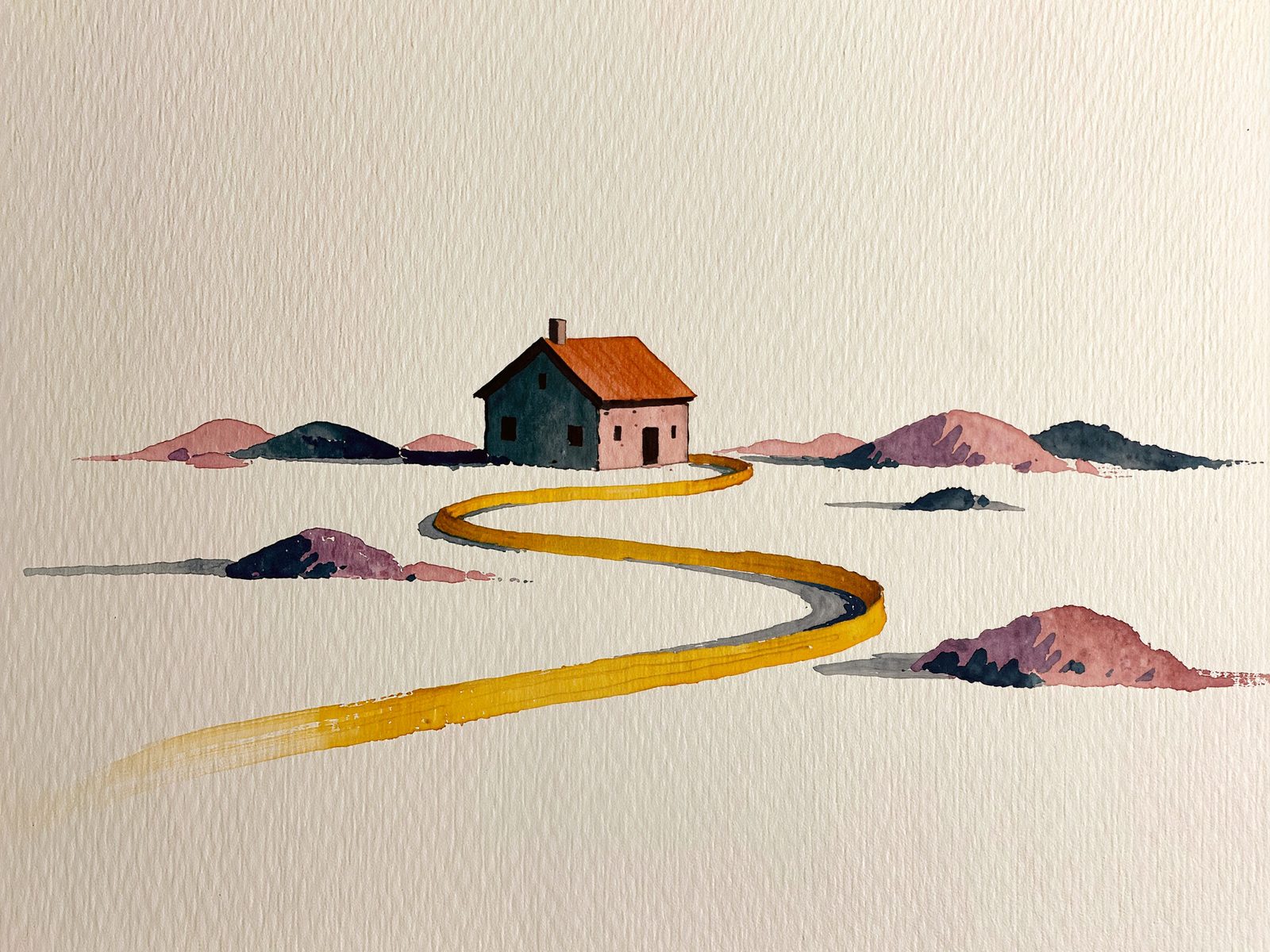
He drew a winding path that seemed to fold in on itself, like a road disappearing into a thickening fog. Along its edges were the needs, expectations and demands of other people. He had placed himself somewhere in the middle, becoming smaller and harder to see with every turn. He sat quietly looking at the picture, and slowly, something began to land.
He could see how long he had been moving through life with his attention turned outwards. His health had slipped further down the list. Rest had become elusive. His own needs had begun to feel like an inconvenience.
At our next session he said something I have never forgotten: “I’ve spent my whole life trying to make sure everyone else is happy. And I have totally failed. Somehow nobody is happy, including me.”
We stayed with the image as he followed the path backwards, and he began to recognise that the pattern had not started with his career, his family or the pressures of adulthood. It went much further back. He remembered being a little boy and learning, almost without anyone saying it, that keeping his mother, his father and his younger brother happy was his most important job, and the thing he was praised for.
That changed the meaning of the picture. The man in the middle of the maze was not simply an exhausted leader who had taken on too much. He was also a little boy who had become very skilled at scanning the room, noticing what everyone else needed, and quietly putting himself further down the list.
I didn’t need to explain that to him. He was already seeing it. Then came the realisation that seemed to take the air from the room: “I’ve become so good at knowing what everyone else wants from me that I don’t know how to hear my own voice anymore.”
That is when the real work could begin. Not goal setting. Not accountability. Helping him build a life that reflected his own values, with healthy boundaries, and without confusing self-respect with selfishness.
Below the behaviour
Many of us stay at the level of behaviour because it feels safer, and for many clients that’s enough. But if you want to make interventions that create meaningful, lasting change, and to develop yourself as deeply as you develop your clients, there is another way. It isn’t about fixing people. It’s about helping them see what has always been there, waiting to be seen.
The answer usually isn’t in thinking harder, or in setting more goals. It’s in seeing differently.
If you’d like to experience this way of working for yourself, and then take it into your own practice, start wherever suits you on our learning pathway.